Sarcopenia: The Silent Aging Crisis
Starting at age 30, the human body loses 3% to 8% of its skeletal muscle mass per decade—a degenerative condition known as sarcopenia. By age 70, this accelerated loss of muscle and bone density leads to frailty, loss of mobility, hip fractures, and nursing home dependency.
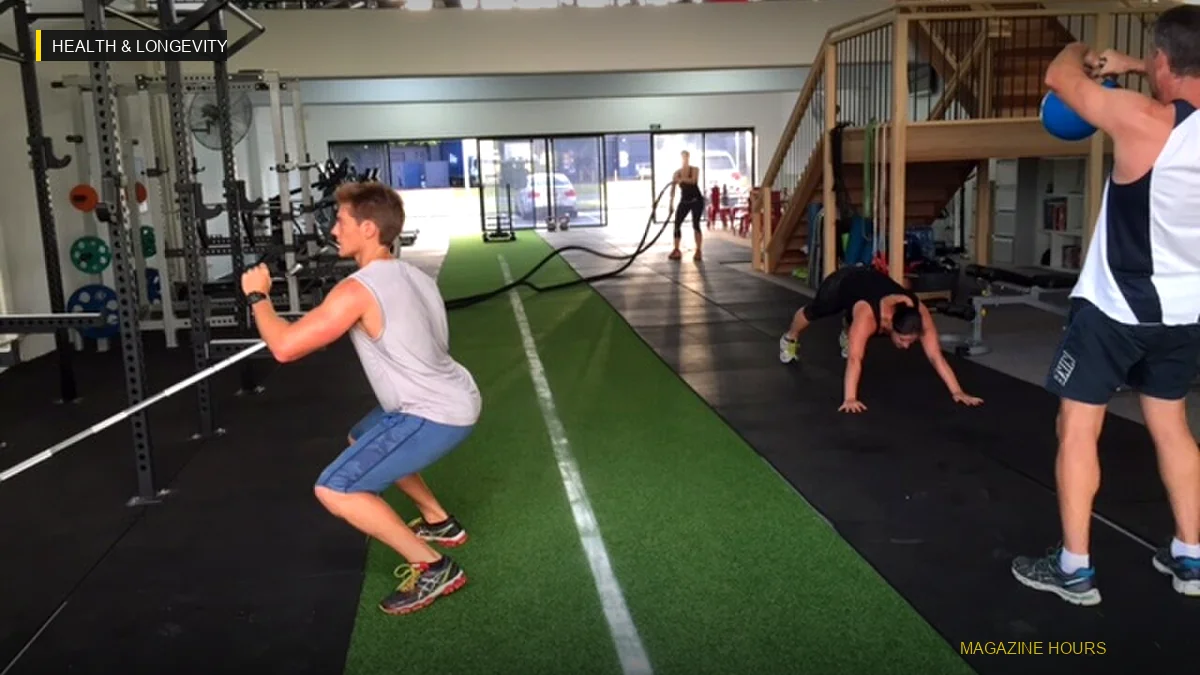
Walking on a treadmill is great for cardiovascular health, but it does nothing to stimulate bone mineral density or rebuild fast-twitch muscle fibers. Progressive resistance training is medicine.

The 5 Foundational Movement Patterns
You do not need 35 complicated machine exercises. Human movement is governed by five primal patterns:
- The Squat (Goblet Squat / Barbell Squat): Preserves knee joint integrity, quadricep power, and the ability to stand up from a low chair without using your hands.
- The Hip Hinge (Deadlift / Romanian Deadlift): Strengthens the posterior chain (hamstrings, glutes, spinal erectors), safeguarding your lower back against disc herniations.
- The Push (Overhead Press / Push-Up / Bench Press): Develops chest, shoulder, and tricep strength for upper-body pushing power.
- The Pull (Barbell Row / Pull-Up / Lat Pulldown): Counters modern desk slouching by strengthening the upper back, rear deltoids, and rhomboids.
- The Carry (Farmer’s Walk): Pick up heavy kettlebells in each hand and walk for 50 paces. Builds crushing grip strength (a clinical biomarker for longevity) and core stability.
The Principle of Progressive Overload
Your body only adapts when given an adaptive stimulus. If you lift the exact same 15-pound dumbbells for 10 reps every week for two years, your body will never build new muscle. Strive to add one more repetition, improve form control, or increase the weight by 2.5 pounds each session.

Key Takeaways and Summary
To put these insights into immediate, practical action:
- Prioritize intentionality: High-value results come from focused execution rather than frantic overexertion.
- Audit your environment: The tools, systems, and routines you tolerate determine your daily cognitive quality.
- Iterate continuously: Treat your habits as ongoing experiments that compound over months and years.